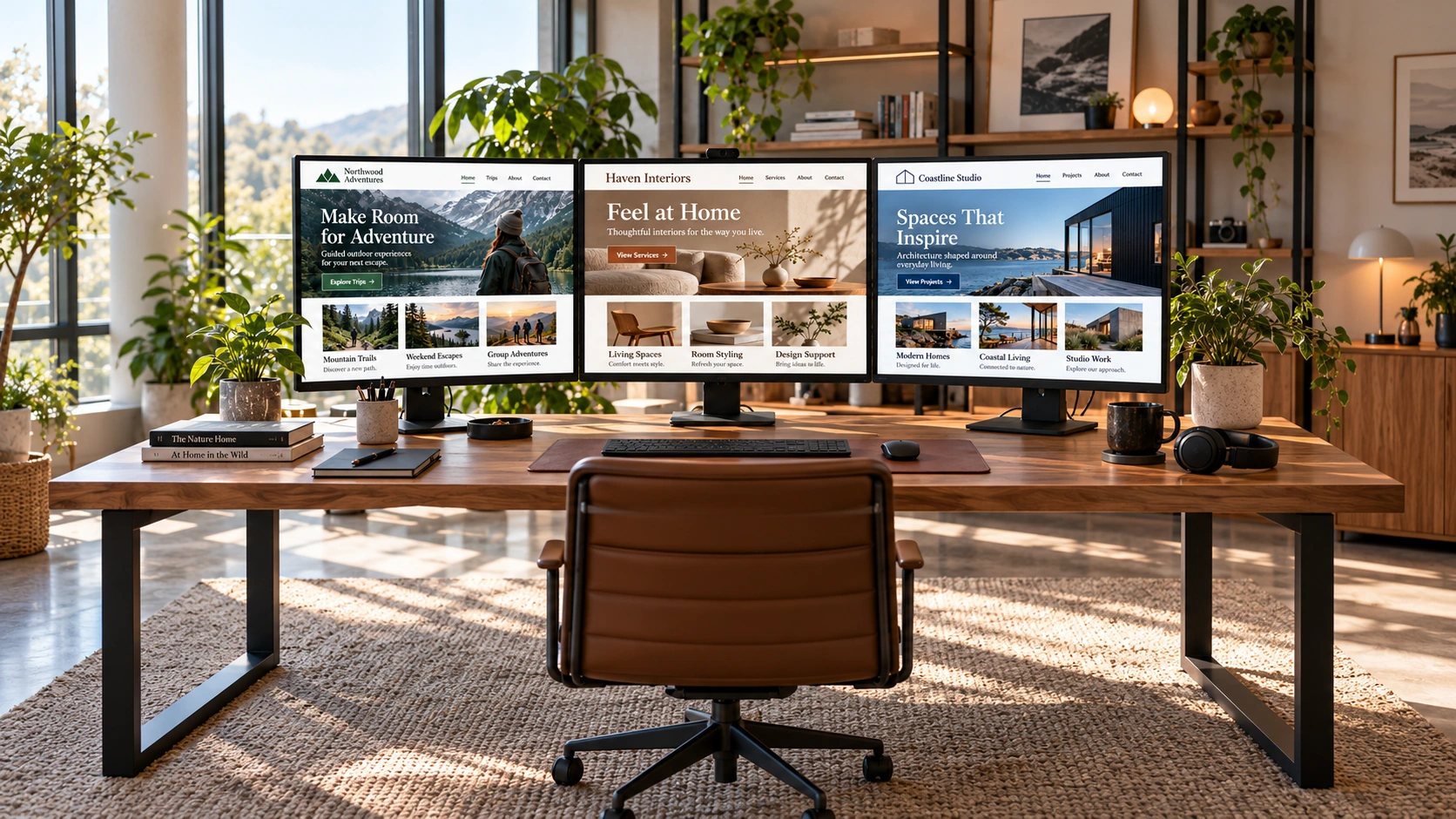
Many business websites feel alike because they rely on familiar layouts, reusable templates and shared design conventions. AI tools can also repeat familiar patterns, but they do not make every website identical. Similarity becomes a business concern when visitors struggle to remember what makes one company different from the next.
Different names, familiar experiences
Open several company websites and the rhythm can feel familiar. There is a large introduction, a prominent button, a few service panels and a section of customer comments. The photographs and names change, while the experience feels much the same.
The title is an observation about a common pattern, rather than a claim that every website is identical. Distinctive sites still exist. The question is why so many businesses end up with an online presentation that feels interchangeable.
Research found a pattern before the current AI boom
A study presented at CHI in 2021 investigated changes in website appearance using images from 2003 through 2019 and interviews with experienced design professionals. The researchers found increasing visual similarity, especially in page layouts.
That research is useful context, but it does not measure all websites in 2026 or prove that today’s AI tools caused the historical trend. The tendency toward similar designs was already being discussed before the current wave of AI website generation.
Familiarity has a useful side
Visitors do not necessarily want to solve a puzzle when they open a business website. A recognizable menu, readable information and an obvious way to contact the company can make the experience feel comfortable.
Shared conventions also help explain why designers repeat certain arrangements. A familiar structure can serve a practical purpose. The existence of a common layout does not, by itself, make a website ineffective or prove that it was copied.
Convenience can blur a company’s identity
Reusable templates make it easier to create a starting point. They also need to work for many types of businesses, which can encourage broad choices that say little about any particular company.
That becomes noticeable when a visitor could swap one business name for another and still read essentially the same presentation. The website may look polished without giving the person much reason to remember the company behind it.
For businesses that depend on personal trust, specialist experience or a distinctive service, that lost identity can matter. A site is often the first introduction a customer receives, and a generic introduction can leave an incomplete impression.
AI can repeat patterns, but the outcome is not inevitable
AI tools can produce familiar looking pages, particularly when the request and the material supplied are broad. That is a possibility, rather than proof that all AI output is a statistical average or that AI cannot help create distinctive work.
The same caution applies to claims about accessibility or performance. A familiar template does not automatically make a website accessible, and an unusual design does not automatically make it difficult to use. Those qualities depend on the finished experience.
A business deserves a recognizable introduction
A useful website helps someone understand the actual company, including the services it offers and the people it serves. Its appearance supports that introduction instead of overwhelming it.
The goal is not novelty for its own sake. A memorable website still needs to feel understandable and credible. Familiar navigation and a recognizable business identity can exist together.
Whether the starting point is a template or a new design, the finished site should represent the business people will actually contact. StartWeb7 builds business websites and offers SEO + AEO management to support opportunities for discovery and customer conversations.