

There was a time when opening a website could feel like opening a toy box. A page loaded, music started, characters danced across the screen, and a simple game waited for a click. For a generation of people who learned the internet on family computers and school library machines, that sense of play did not come from the web as it was first built.
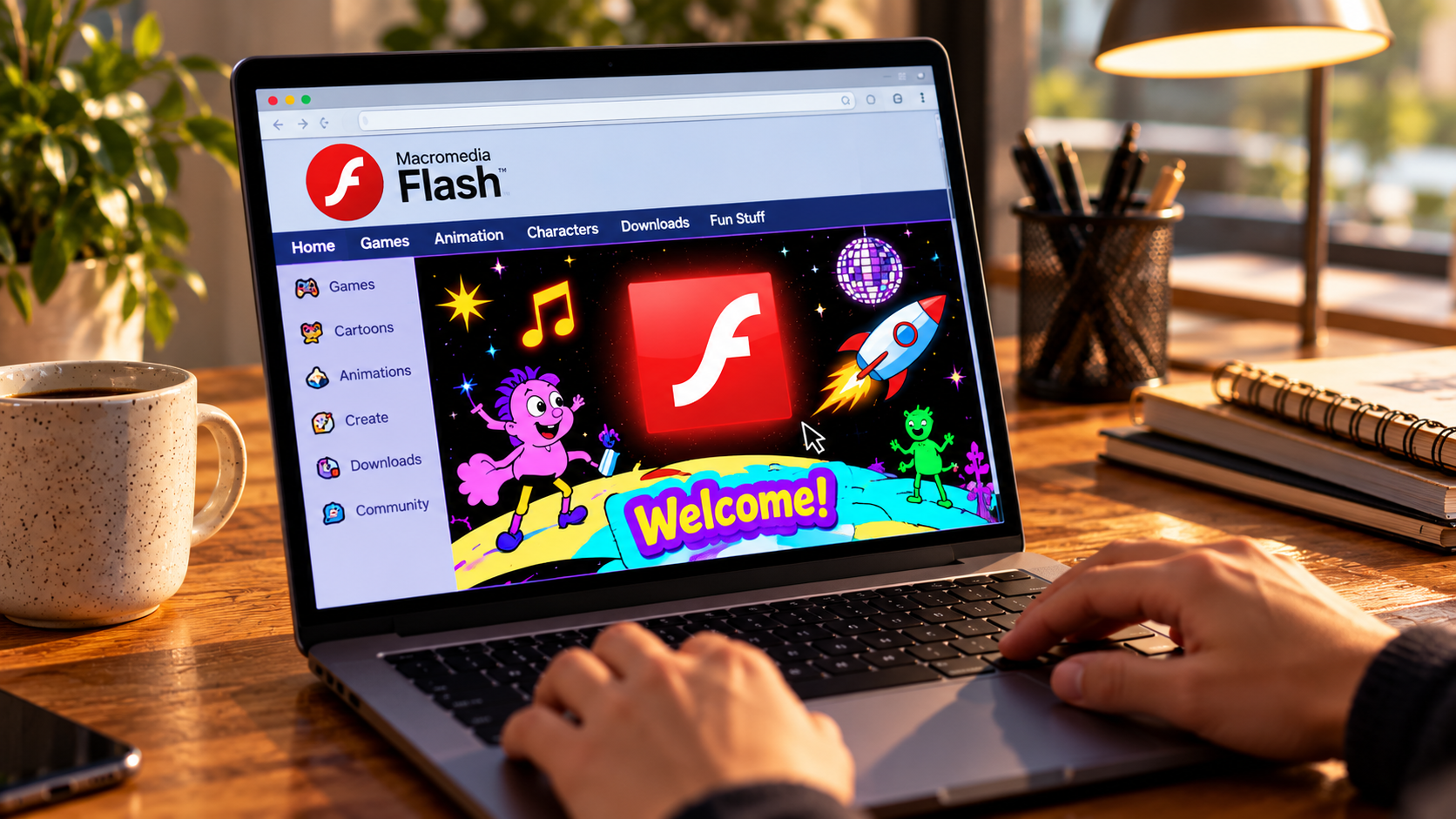
It came from Flash. Before Flash, the web was mostly words, still images, and careful rows of links. It was useful, and it was revolutionary in its own way, but it was also quiet and flat.
Flash changed the feeling of a page. It made the browser a stage, a game console, and eventually a television, all at once. Its disappearance on December 31, 2020, when Adobe ended support, closed more than a software product.
It closed a whole visual language that had taught people what the internet could feel like.
A Small Animation Tool With a Large Idea
The story begins in 1996, when Macromedia acquired an animation tool called FutureSplash and rebranded it as Macromedia Flash 1.0. The timing mattered. Modems were slow, connections dropped, and large files were a problem for almost everyone.
A tool built around compact vector animation offered something the early web badly needed, a way to add movement without asking visitors to wait forever. Color, animation, games, and simple interactivity arrived in places that had been text heavy for years. A greeting could sing.
A menu could respond. A cartoon could run in a browser window instead of on television. Creators who might never have worked in film or traditional software found a format that rewarded imagination more than budget.
That accessibility is part of why Flash spread so quickly. It lowered the distance between having an idea and putting that idea in front of strangers. Students, hobbyists, animators, and early online businesses all experimented with the same tool, and the results were uneven, strange, and often joyful.
The web looked less like a filing cabinet and more like a neighborhood, with every door painted a different color.
When Video Learned to Live in the Browser
Flash grew from a novelty into infrastructure, and video is where that shift became impossible to ignore. Early YouTube, Vimeo, and Hulu depended on Flash video, known as FLV, to play moving images inside a web page. Before that period, online video had been a frustrating patchwork of players, downloads, and formats that behaved differently on different machines.
For ordinary viewers, Flash made pressing play feel normal. A news clip, a music video, a homemade skit, and a trailer could all live in the same browser window. That convenience helped normalize the idea that the internet was not just a place to read about culture, but a place where culture happened first.
The business story followed the creative one. In 2005, Adobe acquired Macromedia for $3.4 billion. The purchase showed how central Flash had become to the commercial web.
Adobe was not buying a passing fad. It was buying the layer through which much of the audience watched, played, clicked, and learned online. At its peak, Flash felt less like a plugin and more like a condition of being on the internet at all.
The Phone That Said No
The turn began with a device that fit in a pocket. Apple refused to allow Flash on the iPhone from its launch in 2007. At first, that decision looked like a missing feature, because so much of the existing web relied on Flash.
A phone that could not play that content seemed incomplete to many observers, and the debate over the choice lasted for years. In April 2010, Steve Jobs published an essay called Thoughts on Flash that turned a product decision into a public argument about the future. Jobs criticized Flash for battery use, mobile performance, security problems, and closed control.
He argued that HTML5 and open standards would win on mobile devices, where touch, efficiency, and reliability mattered more than compatibility with the desktop past. The essay was unusually blunt for a corporate statement, and that bluntness is why it is still remembered. It did not treat Flash as a rival feature to be negotiated with.
It treated Flash as a model that belonged to an earlier era of computing, one built around mice, plugins, and constant power. Whether readers agreed or not, the direction was becoming clear. Adobe ended mobile Flash Player in 2011, a concession that the center of the internet was moving, and it was moving away.
A Long Goodbye, Announced in Advance
Unlike many technologies that fade quietly, Flash received a formal farewell. In 2017, Adobe announced the end of life plan for Flash. Support ended on December 31, 2020, and Adobe blocked Flash content from running starting January 12, 2021.
After that date, the work did not just lose updates. In many browsers, it simply stopped playing. That finality created a strange cultural problem.
Software often disappears when a company closes or a format loses a format war, but Flash had carried an enormous archive of cartoons, games, advertisements, educational tools, and early video experiments. Some of that material had never existed anywhere else. When the player died, the question became whether the history of a creative era should be allowed to vanish with the technology that played it.
Preservation projects such as Flashpoint and Ruffle have worked to keep old Flash works accessible. Their existence says something important about how people now view internet history. What once looked disposable, a silly game shared between friends or a short cartoon passed around by email, is now treated as worth saving.
The jokes, styles, and experiments of the early social web were a record of how a culture learned to express itself online.
What the Flash Era Left Behind
It is tempting to remember Flash only for its flaws, and the flaws were real in the telling of its critics, especially around security, performance, and dependence on a single company. But reducing the era to those flaws misses why millions of people cared when it ended. Flash gave the web a sense of mischief.
It invited exaggeration, noise, color, and surprise at a time when much of online life was becoming standardized. Today, websites are faster, safer, and far more capable on phones, and HTML5 and modern browsers absorbed many of the jobs Flash once handled alone. Video plays without a special plugin.
Animation is built into the ordinary tools of the web. Games run in browsers that would have astonished the audience of 1996. In that sense, Flash did not lose every argument.
Its central belief, that people wanted a rich and moving web, became the default expectation. What vanished was the single gatekeeper format and the amateur chaos that came with it. The modern web is smoother, but it is also more uniform, shaped by platforms, templates, and feeds.
Flash belonged to a messier internet, where a strange idea could look exactly as strange as its creator wanted. When people mourn Flash, they are rarely mourning a plugin. They are mourning the feeling that the web was still being invented in public, one noisy, animated page at a time.
Why This Still Matters for Business Websites
The most useful lesson from Flash is not that movement is bad. It is that design has to serve the visitor. A pool contractor's website can have a beautiful video of a finished pool, but someone searching for tile repair still needs to find that service quickly.
A security company's animation might establish a polished first impression, but it cannot replace a clear explanation of where guards work and how a customer can request coverage.
Modern web design makes motion possible without relying on a separate browser plugin. The challenge is restraint. Video should not make the page painfully slow on a phone.
Animated elements should not prevent someone using assistive technology from finding the information they need. The page should remain readable and functional even when motion is reduced or a network connection is weak.
That also matters for search. Search engines need accessible text, sensible headings, and reliable page performance to understand a company's services. The most elaborate visual experience cannot compensate for a page that never clearly explains what the business does.
Flash's legacy is the creative ambition it brought to the web, paired with a reminder that customers should never have to fight a website to use it.