
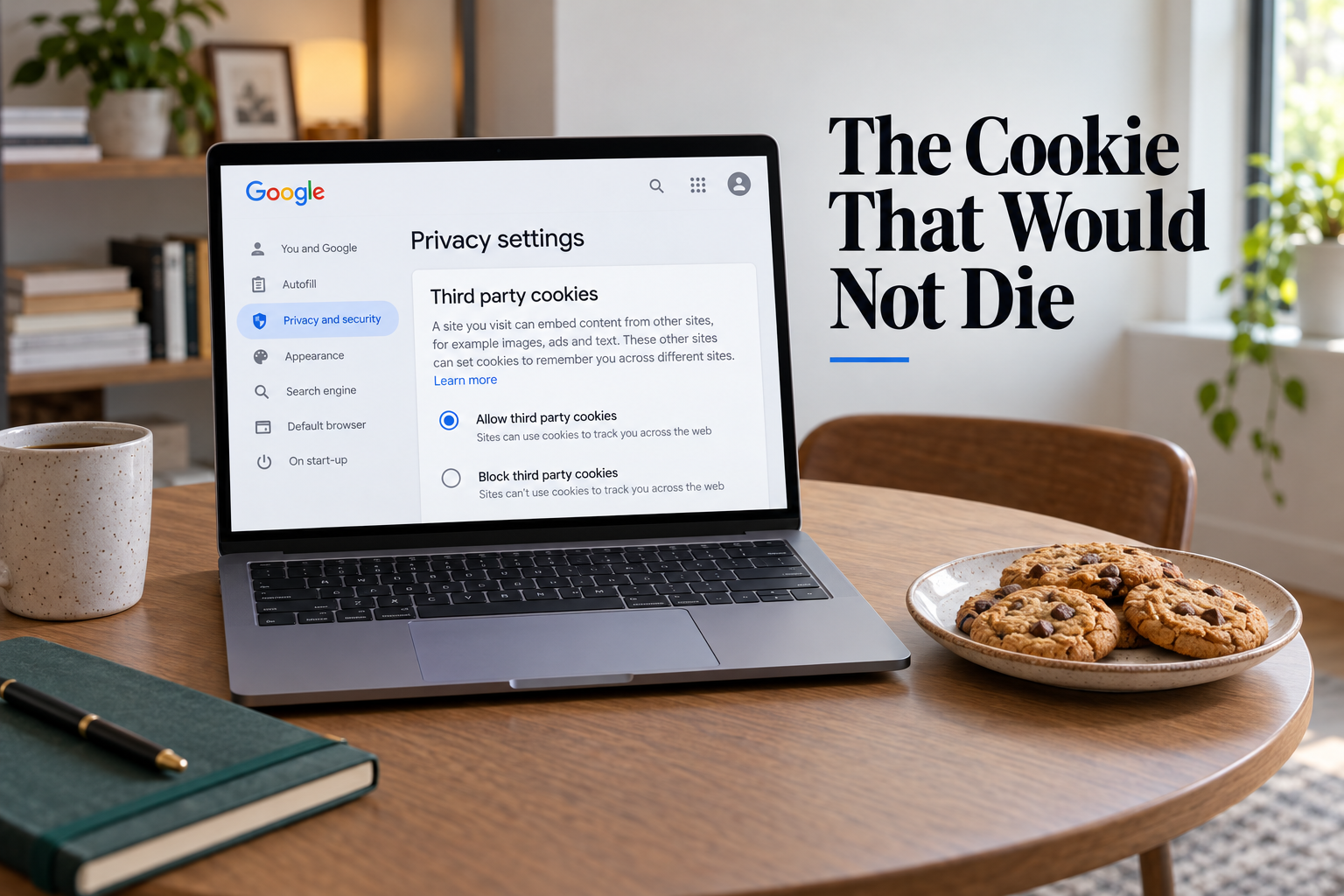
In January 2020, Google announced that it intended to phase out third party cookies in Chrome within two years. After repeated delays, it changed course in July 2024 and confirmed in April 2025 that it would keep its existing approach to cookie choice without a new standalone prompt. The cookie survived, and later in 2025 Google announced the retirement of several proposed replacement technologies.
A small file with an enormous job
A third party cookie is a tiny file placed on your browser by a domain other than the site you are visiting. It sounds trivial. It became the plumbing of the modern ad economy. Because the same advertising company could place and read its cookie across thousands of unrelated sites, it could follow a person around the web, build a picture of their interests, and decide which ads to show them and what those ads were worth.
That plumbing was always controversial. Tracking across unrelated sites raises privacy concerns because a person may not understand which companies are collecting information or how it is being used. Different browsers responded with different protections.
In March 2020, Apple’s WebKit team announced full third party cookie blocking in Safari. Firefox also adopted protections against third party tracking cookies. Those distinctions matter, blocking tracking cookies and blocking every third party cookie are not necessarily the same policy.
The promise, made with a date attached
Google had launched its Privacy Sandbox initiative in August 2019, presenting it as a way to protect privacy while keeping an ad supported web alive. Then, on January 14, 2020, Chrome engineering director Justin Schuh put a date on the future. Google intended to phase out support for third party cookies in Chrome within two years.
Google argued that simply blocking cookies could encourage less visible workarounds, including fingerprinting. It wanted alternatives that could support advertising while improving privacy. Its announcement presented the two year timeline as an intention dependent on developing those alternatives, rather than an unconditional deadline.
The replacements had memorable names and difficult births. One early proposal, Federated Learning of Cohorts, or FLoC, would group people with similar browsing into cohorts advertisers could target. Critics argued it could still expose sensitive interests and handed even more power to the browser maker. FLoC was later dropped in favor of the Topics API, which had the browser note general topics of interest instead. Each new idea arrived with fresh arguments about whether it worked well enough, and for whom.
The regulator in the room
Google also faced competition concerns. Britain’s Competition and Markets Authority opened an investigation in January 2021 into whether the proposed changes could distort competition. That scrutiny made the story about more than browser engineering.
In February 2022, the regulator accepted commitments governing Google’s development of the proposals. Privacy protections, the effect on competing companies, and the practical operation of advertising all had to be considered together.
Meanwhile, the deadline began its long slide. In June 2021, Google pushed the phase out to late 2023. In July 2022, the target moved to the second half of 2024. In April 2024, it slipped to 2025 at the earliest, pending regulators. An industry that had reorganized around the original two year promise was now four years in, still preparing, and increasingly unsure the day would come.
The reversal arrives in two acts
Act one came on July 22, 2024. Anthony Chavez, Google's vice president for the Privacy Sandbox, announced that Google would no longer deprecate third party cookies. Instead, Google proposed an updated approach built around user choice. Chrome would introduce a new experience letting people make an informed choice that applied across their browsing, and adjust that choice at any time.
The language was careful, but the direction had changed. Instead of ending support for third party cookies, Google proposed an experience through which users could make a choice across their browsing. It acknowledged the work involved in a transition and the effect on publishers and advertisers.
Act two was quieter. On April 22, 2025, Chavez announced Google would maintain its current approach to third party cookie choice in Chrome, and would not roll out a new standalone prompt. Users could keep making choices in Chrome's Privacy and Security Settings, as before. The grand prompt, centerpiece of the user choice plan, was gone less than a year after it was proposed.
The story continued after the prompt was dropped. On October 17, 2025, Google announced that it would retire several Privacy Sandbox technologies, including Topics, Protected Audience, and Attribution Reporting. It said low adoption and feedback about their expected value informed the decision, while other technologies would continue to receive support.
What five years of preparing left behind
It would be too simple to say nothing changed. Browser privacy protections continued to differ, and the discussion brought more attention to the relationship between tracking and the advertising that supports many websites. The reversal did not erase the underlying privacy concerns.
Repeated changes can make preparation difficult. A publisher or advertiser planning around a browser update has to decide what to build before every detail is settled. This story shows how a roadmap from one widely used browser can influence decisions across the web, even when that roadmap later changes.
The privacy debate itself never resolved. Critics of the reversal argue that keeping cookies in the dominant browser preserves a system of cross site tracking that its rivals abandoned years ago, and that burying the choice in settings most people never open is choice in name only. Defenders of Google's caution argue that a badly designed replacement could have entrenched Google further, damaged the open web's economics, and pushed tracking into less visible forms. Both arguments can be true at once, which is part of why the argument never ended.
What is certain is the strangeness of the ending. The third party cookie was formally sentenced in 2020, granted delay after delay, and then quietly reprieved. It survives not because anyone declared it good, but because replacing it turned out to be harder and riskier than ending it ever sounded in a blog post.
The cookie survived the planned phase out. The larger argument about privacy, advertising, and the economics of the web remains unresolved.
Sources
- Chromium, January 2020 cookie phase out announcement
- Google, July 2024 change in approach
- Google, April 2025 cookie choice update
- Google, October 2025 technology retirement announcement
- Competition and Markets Authority, investigation and dated updates
- WebKit, March 2020 Safari cookie blocking announcement