
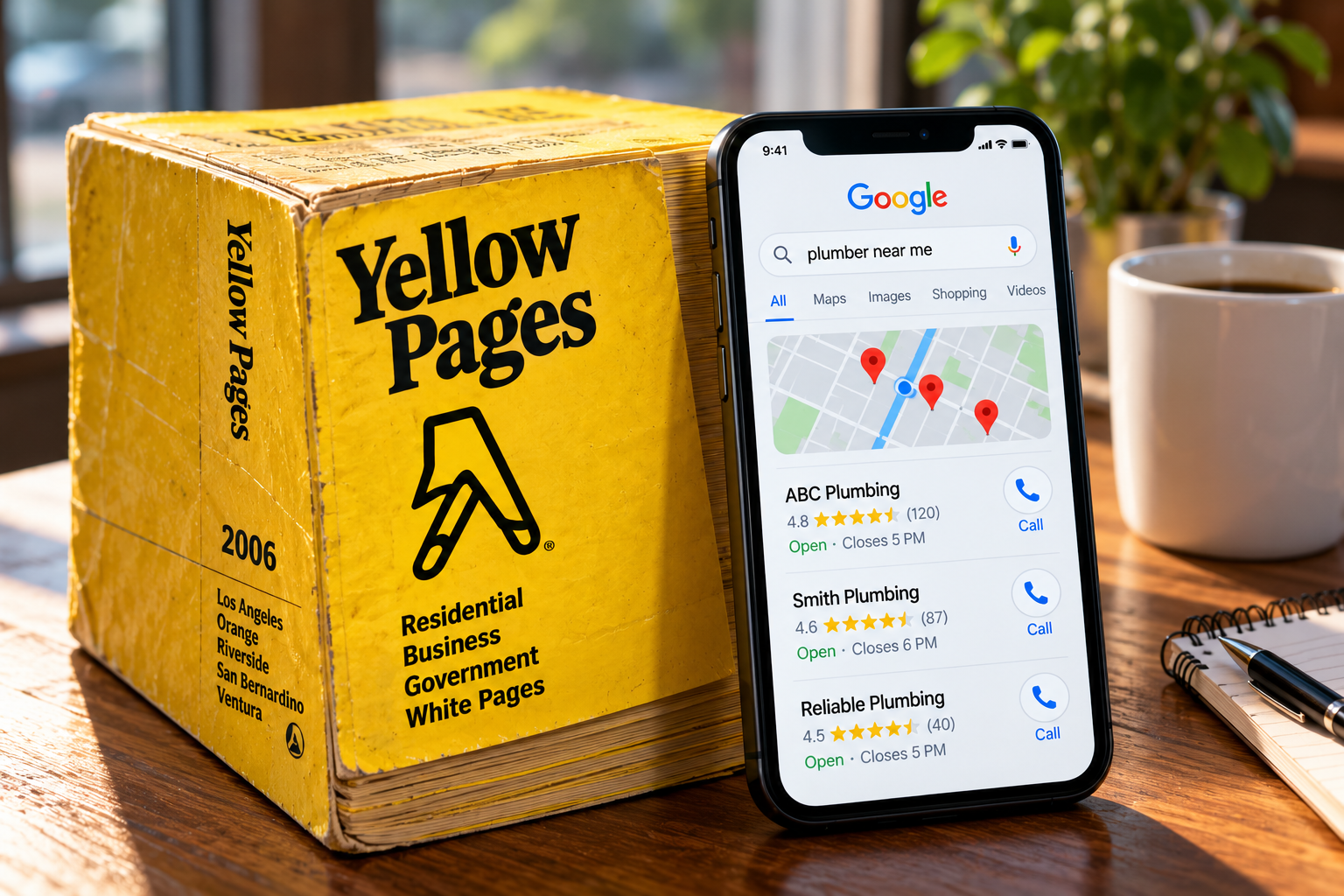
It arrived without anyone asking for it, thick, yellow, and heavy enough to prop open a door. It landed on porches and in hallways once a year, and for decades it held a quiet kind of power. If a sink leaked at midnight, if a car would not start before work, if a family needed a restaurant, a lawyer, or a florist in an unfamiliar town, the answer began with the same motion.
Find the book, find the category, and let your fingers do the walking. The Yellow Pages was not glamorous, and that was part of its authority. It was not entertainment, news, or advertising in the usual sense, even though advertising filled its pages.
It was infrastructure. Every household received roughly the same map of local commerce, printed on yellow paper, organized by need. Before search results could be personalized, ranked, and refreshed by the second, that shared book was how a community agreed on who existed.
A Directory Printed on Yellow Paper
The first official Yellow Pages directory dates to 1886, when printed business listings on yellow paper became the model for a new kind of publication. Residential listings belonged in the white pages. Businesses belonged in the yellow section, arranged by category rather than only by name.
That distinction sounds simple now, but it changed how people shopped. A customer did not need to know a company in advance. They needed to know what problem they had.
In the United Kingdom, the first edition was published in Brighton in 1966, beginning a run that would become part of everyday British life as well. The format traveled because the problem traveled. Every town had trades, shops, and services, and every household had moments when a trusted list mattered more than a recommendation from a neighbor who might not be home.
For decades, businesses paid for listings and display ads in an annual printed book that was delivered free to homes. Size mattered in a literal way. A larger ad, a bolder listing, and a place under the right heading could shape who received the call when a stranger opened the book.
If you needed a plumber, you flipped to the category, compared names on the page, and chose from what the page gave you.
Visibility You Bought Once a Year
That annual rhythm created a particular kind of business anxiety. Miss the deadline, choose the wrong category, or appear smaller than a competitor, and the mistake could sit in homes for a full year. There was no quiet edit in the morning and no new photograph added in the afternoon.
Print rewarded planning and permanence, and it punished change. It also offered a clarity that later systems rarely matched. A business knew where it appeared, what the ad cost, and who else appeared beside it.
Neighbors saw the same page. There was little mystery about placement, even if there was fierce competition for attention within the column. Visibility was paid, bounded, and physical.
You could hold the market in your hands and turn its pages. At its height in the United Kingdom, the Yellow Pages reached over 27 million households, with more than a million businesses advertising, according to the account of its final years. Numbers like that explain why the book was never just a directory to the companies inside it.
It was a yearly decision about survival in local trade, made long before a customer knew they would need help.
The Phone in Every Pocket
Search engines and smartphones replaced the book because they answered the same need with fewer limits. Listings could update in real time, carry reviews, photographs, and hours, and be measured in ways print never could. A closed shop could change its holiday schedule the same day.
A customer could see distance, ratings, and directions without leaving the screen. A business could learn how many people had viewed, called, or asked for directions. The change was not only about convenience.
It was about expectation. Once people became used to information that corrected itself, an annual book began to feel like a photograph of a town that had already moved. The category system survived in spirit, because search still begins with a need, but the page became fluid.
No two people necessarily saw the same results, in the same order, for the same reason. That difference is the heart of the debate the Yellow Pages leaves behind. Annual, paid, unmeasurable visibility had obvious limits, but it was shared.
Daily, earned, measurable visibility is richer and more responsive, but it can also feel invisible in its workings. A printed ad either was on the page or it was not. A modern listing can be present, buried, praised, misreported, or overtaken, and the owner may not know which story a customer saw.
Brighton, the First Town and the Last Delivery
The ending in the United Kingdom had a symmetry that made it hard to ignore. Yell announced in 2017 that print would end, and final printed copies were delivered in Brighton in January 2019, after a 53 year run. The first edition had been Brighton in 1966.
The last copies returned to the same place, carrying the weight of every kitchen drawer and hallway table the book had occupied since then. In the United States, print directories declined on different schedules depending on the publisher and local market. The 2019 date refers specifically to the final major British Yellow Pages print delivery, not a universal end date for American directories.
Some editions lingered in smaller forms and narrower markets, but the era of the universal local book was over. The object that had once been too useful to throw away had become, for many households, a recycling problem on delivery day. The Yellow Pages name survives online as digital directories and services.
That survival matters, because the need never disappeared. People still look for help close to home, still compare trust signals, and still choose quickly in moments of stress. What changed was the medium and the rules of being found.
The book became a website, the category became a query, and the paid box on a page became part of a much wider contest for attention.
What Was Lost With the Shared Page
It would be easy to romanticize the yellow book, and just as easy to mock it. It wasted paper, froze information in place, and gave larger budgets a visible advantage. It could not carry a customer review, a same day closure, or a photograph of finished work.
By almost any practical measure, search serves people better in the moment of need. And still, something was lost when the shared local reference went away. The Yellow Pages treated local commerce as a common civic list.
Everyone argued from roughly the same page. A new business and an established name could be found through the same habit, by opening the same book that sat in nearly every home. Trust came from presence, familiarity, and the simple fact that the business had a place in the town's printed record.
Today that trust is assembled in pieces, from ratings, reviews, maps, photographs, websites, and recommendations that shift with every search. It is more information, and often better information, but it is not shared in the same way. The big yellow book ran local business because it ran local attention first.
When it closed, local life did not stop being local. It just stopped arriving once a year, all at once, on yellow paper.
From the Printed Category to the Search Question
The old directory organized businesses by category because customers usually started with a problem, not a company name. That is still true online. Someone searching for pool resurfacing is asking a different question from someone looking for leak detection.
A business that describes both services only as general pool work may not explain either one clearly enough.
Modern SEO builds on that distinction. Useful service pages describe the actual work, the situations that make someone need it, and the places the company serves. Accurate business profiles, working contact options, and relevant internal links help people move from a search result to a decision.
The point is not simply to appear in more places. It is to attract inquiries from people who need the service being offered.
AI assisted search adds another layer. A system may summarize several sources instead of presenting only a traditional list of links. That makes clear, well organized answers and reliable business details especially valuable.
AEO is one way to describe the work of making those answers understandable to search and answer systems, although no website can guarantee inclusion in an AI response.
The medium changed, but the central challenge did not. A customer has a problem. A business has a solution.
The information between them must make the connection possible.