
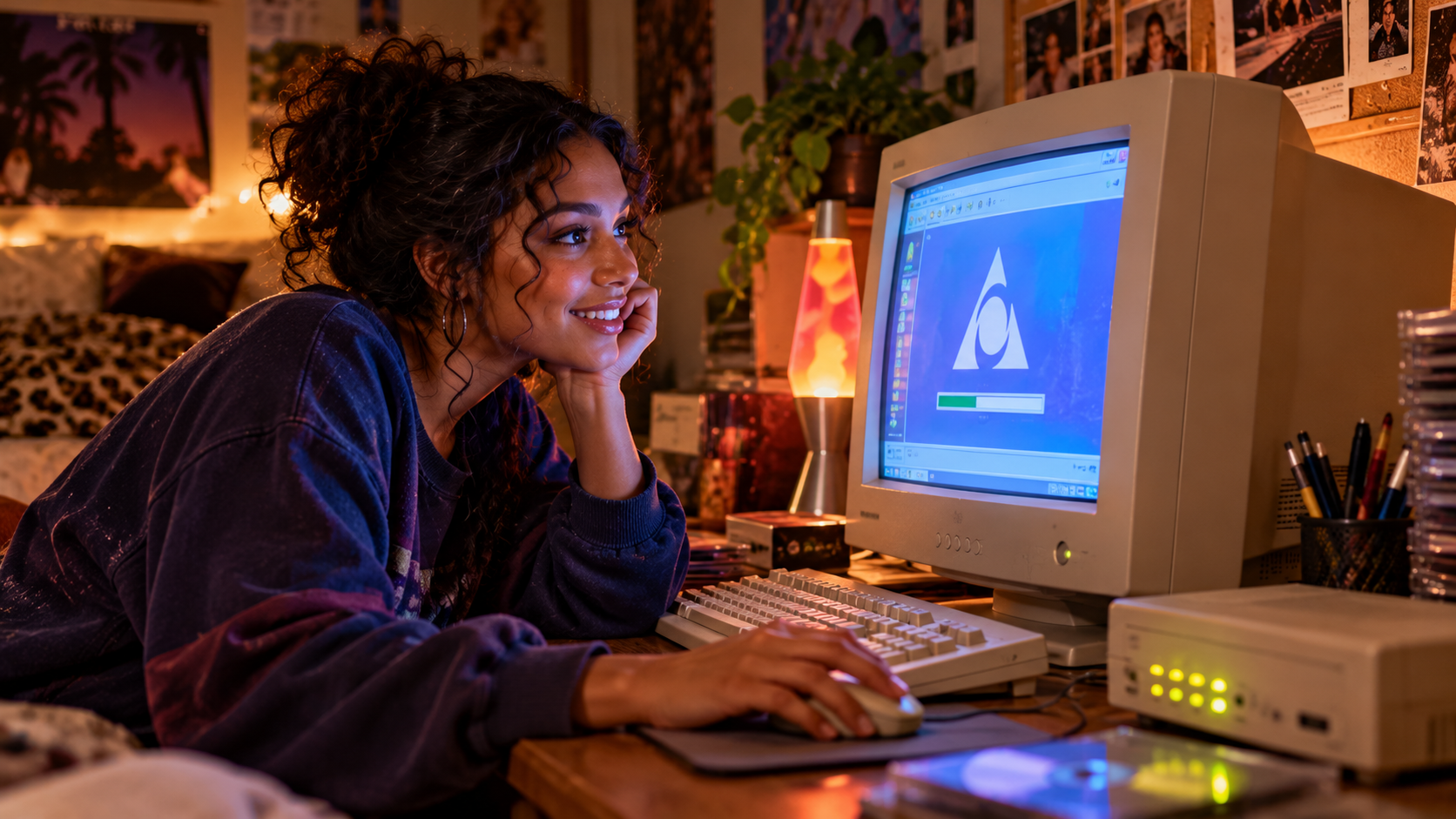
For a long stretch of the 1990s, going online did not start with a tap or a click. It started with waiting. Someone in the house had to be off the phone, the modem had to dial, and then came a short burst of beeps, hisses, and static that sounded like a robot trying to sing through a kazoo. If the connection held, a friendly male voice would greet you with two simple words, Welcome, and then, if you were lucky, three more that could change the mood of an entire room. You have got mail. That greeting belonged to America Online, known everywhere as AOL, and for millions of people it was not a sound effect. It was the internet itself announcing that it had arrived in their home. Long before push notifications, unread badges, and lock screens crowded with alerts, that one cheerful sentence carried all the excitement of modern messaging in a single moment. Someone, somewhere, had thought of you, written to you, and sent that message across a network you could barely picture, and it was waiting.
A Voice Recorded on a Cassette in a Living Room
The most famous voice of the early internet was never recorded in a famous studio. In 1989, Steve Case, the chief executive of Quantum Computer Services, wanted to add a human voice to the company Quantum Link online service. Quantum would later become America Online. Karen Edwards, who worked as a customer service representative, overheard the conversation and suggested her husband, Elwood Edwards, a professional broadcaster with years of work in radio and television. Edwards sat down in his living room with a cassette recorder and recorded a short set of phrases, Welcome, You have got mail, File is done, and Goodbye, along with a few related lines that followed later. He was paid 200 dollars for the session. There was no way to know in that room, with that modest equipment, that the recording would be heard hundreds of millions of times, or that Edwards later estimated it was being heard more than 35 million times a day at its height. That origin story matters because it captures the scale of what followed. The internet that most Americans first met grew out of ordinary rooms and small decisions that turned out to be enormous. A broadcaster helping out through his wife, a cassette tape, and a company trying to sound less like a machine added up to a voice that made the unfamiliar experience of checking an electronic inbox feel personal. Edwards died on November 5, 2024, one day before his 75th birthday, and the obituaries that followed read less like notices for a voice actor and more like farewells to an era.
The Ritual of Getting Online
Part of the power of that greeting was that getting online used to be an event. Dial-up tied up the household telephone line, so a session online meant no calls in or out. Families negotiated time the way they negotiated the television remote. Teenagers learned to listen for a parent picking up an extension, because that small click could end the connection, and parents learned that a busy signal all evening meant someone was deep in a chat room. Speed shaped everything. Dial-up topped out at 56 kilobits per second, a fraction of what a modern phone connection handles without anyone noticing. A photograph could appear slowly, line by line, slowly revealing itself from the top down. Downloading a song was a commitment. Leaving the computer alone while a file crept toward completion became a normal part of life, and the File is done announcement that Edwards also recorded carried its own small celebration. Because connecting took effort, being connected felt deliberate. People planned sessions. They checked email, visited a handful of favorite places, posted in a forum, and signed off so the phone would be free again. The Goodbye that Edwards recorded at the end of a session was not just politeness. It marked a real leaving, a return to the offline house, the ringing phone, and the rest of the evening.
A Walled Garden That Felt Like a Town
AOL did more than provide a connection. It provided a place. Once inside, members found email, chat rooms organized by interest, instant messaging through AIM, news, games, and guided areas that sorted the sprawling web into something a newcomer could walk through without a map. Critics later called it a walled garden, and the description was fair, but for a first time user in 1995 or 1998, a garden with paths was far less frightening than an open wilderness. Screen names became part of that culture. People chose handles that hid their legal names and announced their humor, their hobbies, or their teenage sense of drama. The anonymity was imperfect and sometimes rowdy, but it also gave shy people a way to speak, gave far flung hobbyists a way to find each other, and gave families in different states a cheap, cheerful way to stay in daily contact that letters and long distance calls never quite matched. The company spread through one of the most visible marketing efforts of the decade, a flood of free trial disks and later CDs that arrived in mailboxes, magazines, and cereal boxes. At its peak around 2000, AOL counted about 25 million subscribers, and by some accounts more than 26 million, and it carried a huge share of the consumer internet traffic in the United States. For a time, asking whether someone was online often meant asking whether they were on AOL. The phrase reached its pop culture peak in 1998, when the film You Have Got Mail, starring Tom Hanks and Meg Ryan, built a romantic comedy around two rival booksellers falling for each other through anonymous AOL messages. The movie works as a time capsule today, with its bookstore wars and its modem sounds, but it also shows how completely the service had entered everyday language. A notification sound had become a movie title that needed no explanation.
The Long Fade and the Final Goodbye
Broadband changed the bargain. Cable and DSL connections stayed on all day, freed the phone line, and made the old ritual of dialing, waiting, and signing off feel like a chore from another life. The walled garden also mattered less as the open web grew easier to navigate and search engines guided people directly to what they wanted. AOL merged with Time Warner in 2000 in a deal that became a symbol of the dot com boom and its excesses, and the company passed through several owners in the years that followed, including Verizon, before landing with Apollo Global Management in 2021 as part of Yahoo. AIM shut down in 2017, closing the instant messaging service that had shaped how a generation typed, abbreviated, and set away messages like diary entries. Dial-up, remarkably, hung on far longer. As recently as 2023, Census estimates counted about 163,000 households in the United States still relying on dial-up, many in places where faster service remained unavailable or unaffordable. Nostalgia was only part of the story. For those households, the modem handshake was not a memory, it was still the only road in. On September 30, 2025, AOL discontinued its dial-up service for good, retiring the AOL Dialer software and the AOL Shield browser along with it, after more than three decades. The company described the move as a routine product evaluation, which is a quiet way to close a loud chapter. The screech that once filled living rooms will now survive mainly in recordings, museum pieces, and the muscle memory of anyone who ever held their breath waiting for a connection to catch.
Why That Voice Still Echoes
It is tempting to treat the whole era as a joke about slow speeds and free CDs turned into coasters, and plenty of those jokes are affectionate and earned. Yet something real was learned in those years, and it was learned through sound and ritual as much as through technology. AOL taught people to expect a message to be waiting, to feel a small lift at an alert, to build an identity around a screen name, and to think of a network as a social place rather than a technical one. Modern notifications reflect some of the same design principles: signaling attention, rewarding anticipation, and making a digital action feel immediate. The banners, pings, and badges that compete for attention today are descendants of a friendlier, slower announcement that arrived only after a household negotiation and a modem song. The difference is that the old greeting felt like news from a person, while many new alerts feel like demands from a system. That contrast may be why the clip still circulates whenever the early internet is remembered. People are not only nostalgic for a voice. They are nostalgic for a time when hearing from the online world felt rare enough to celebrate, and simple enough to understand, three words at a time.