
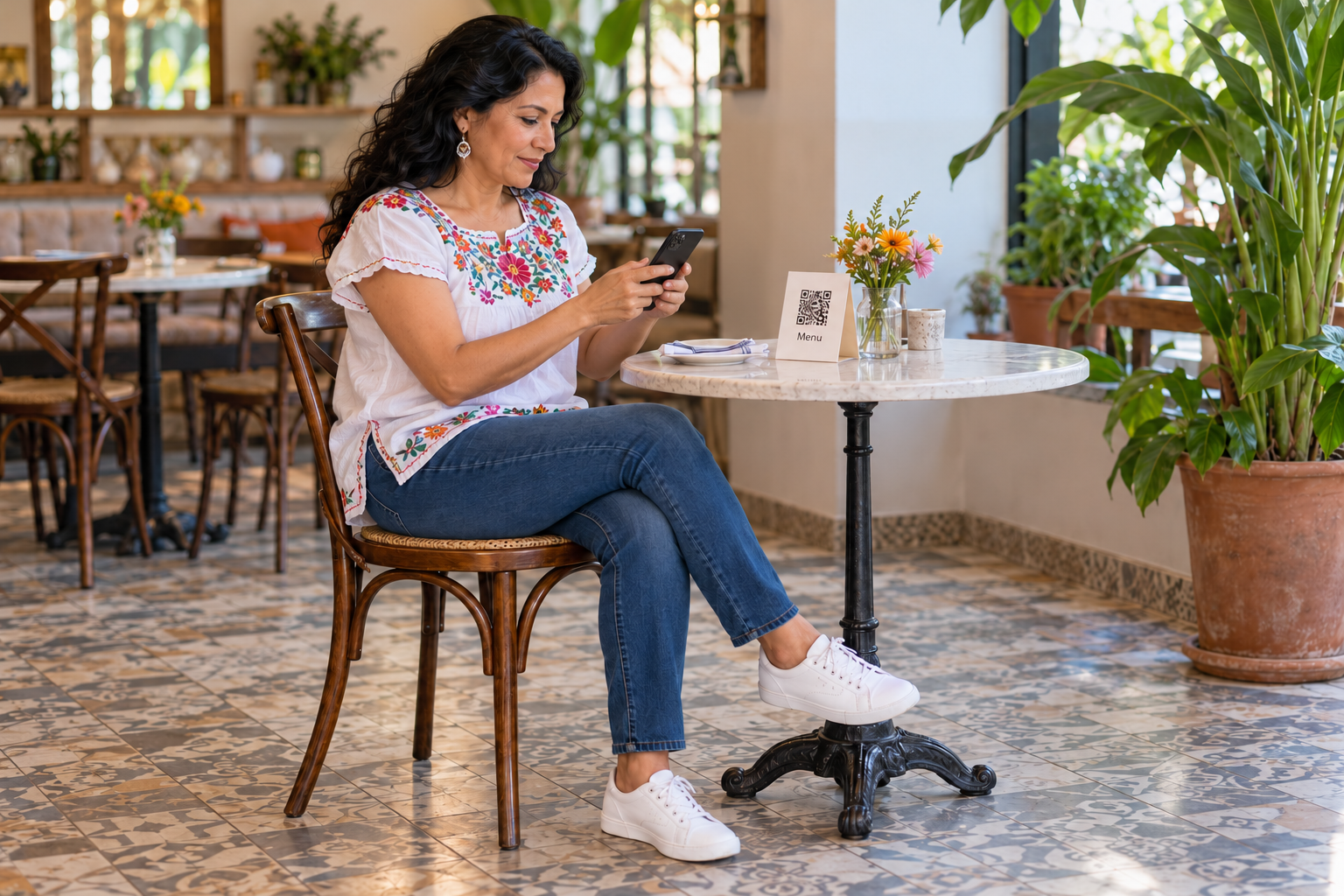
QR codes became a familiar part of American restaurant visits as smartphone cameras made scanning easier and the pandemic accelerated demand for contactless menus. The technology itself was much older and had already found widespread use in Japan. Its later American resurgence shows how a useful invention can gain a new audience when devices, habits, and circumstances align.
For many American consumers, the square once sat unnoticed in the corner of posters, receipts, and product boxes. It looked technical, like something meant for warehouses rather than everyday customers. Later, restaurant tables made it a routine part of deciding what to order. That change was dramatic in the United States, but it was not the beginning of the technology’s usefulness elsewhere.
The QR code’s American comeback is easier to understand when its history is separated from its reputation. It had a proven role in manufacturing long before diners encountered it on a menu stand. The experience around it changed as scanning became simpler, and a familiar criticism returned with its popularity, whether a digital shortcut actually makes life easier for the person using it.
Born in a factory in Japan
DENSO WAVE introduced the QR code in Japan in 1994. It was developed for fast, reliable information reading and adopted in automotive production and related work. The letters stand for Quick Response. Its original purpose was practical, allowing information to move efficiently through settings where speed and accuracy mattered.
A QR code carries information across a two dimensional pattern rather than a single row of bars. The format can represent links, text, and other data in a compact space. Its recognizable corner patterns help a scanner identify orientation. Those capabilities explain why a design developed for industrial work could later become useful on packaging, tickets, and printed materials.
DENSO WAVE’s history records widespread public use in Japan in 2002, helped by mobile phones that could read the codes. That earlier adoption matters. The later restaurant boom was an expansion into a different setting and audience, not the rescue of a technology that everyone had rejected.
The app problem and the long shrug
Early American attempts to bring QR codes to shoppers ran into a simple friction. A person who saw a code in a magazine or on a sign usually needed a separate app to scan it. Downloading software, opening it, and aiming it correctly, all to reach a website that might not be worth the effort, asked too much for too little reward. Many campaigns offered a dull destination at the end of that work, which taught people that scanning was rarely worth it.
The square acquired a reputation as a gimmick in some American marketing. A code placed where someone could not easily stop, scan, or get online created effort without much reward. The technology could work perfectly while the overall experience felt inconvenient. That gap helps explain why a successful industrial tool did not become an equally successful consumer habit everywhere at once.
Apple’s iOS 11 added system support for recognizing QR codes in Camera and Safari. Apple’s own developer material documents the feature. Removing the separate scanning app reduced the effort between noticing a code and opening its destination. It made the same printed square easier to use without changing what the square represented.
The pandemic made it familiar at restaurant tables
During the pandemic, restaurants sought ways to reduce shared handling and adjust how they served guests. A printed code could link to a menu without requiring a reusable menu to pass from one person to another. Restaurants could also change a linked menu without replacing every printed copy. The code became a practical part of a wider adjustment to service.
Diners learned the process through repetition, hold up a phone, open the detected link, and read the menu. A March 2022 QSR Web commentary described rapid restaurant adoption and the operational appeal of digital menus. That account captures how operators were discussing the technology during the period. A tool that had once required explanation was becoming familiar through ordinary restaurant visits.
Familiarity helped the habit persist beyond the circumstances that accelerated it. Once someone has scanned menus repeatedly, the printed square no longer needs much explanation. That does not make it the preferred option for every diner. Convenience depends on the device, the connection, the person, and the menu that opens.
The argument that never quite ended
Not everyone experienced the comeback as progress. The debate that started during the pandemic has continued in dining rooms, opinion columns, and everyday conversation, and it reveals larger tensions about phones at the table and who gets left out when a service moves onto a screen.
Some diners simply miss paper menus. A large printed menu can be shared, scanned at a glance, and read without pinching, zooming, or waiting for a page to load on a weak connection. There is also a social complaint. A meal out once began with everyone looking at the same kind of object. It now often begins with everyone looking down at separate phones, which can feel less like hospitality and more like homework before dinner.
Accessibility concerns remain a serious part of the discussion. A QR only menu assumes a guest has a charged smartphone, a data connection or venue WiFi, adequate vision for a small screen, and the comfort to navigate a mobile site. Older diners, people with visual impairments, and people without reliable devices can find the process frustrating or exclusionary. Many restaurants kept paper menus available on request, but critics note that having to ask for the accessible option is itself a different experience from being handed it as a matter of course.
Security adds another complication. The Federal Trade Commission has warned that harmful links can be concealed in QR codes and that scammers may cover a legitimate code with a different one. The square is a way of encoding information, not a visible guarantee that the destination is genuine. That distinction complicates the idea of scanning as a completely frictionless interaction.
A square that waited for its moment
The QR code story resists a simple invention and triumph narrative. It began in industrial use, reached the Japanese public years before the pandemic, and later became more familiar to American diners. Those different stages show how adoption depends on context. A capability can already be useful somewhere while still feeling unnecessary somewhere else.
Its history also separates technical capability from a good customer experience. A code can be readable while the linked page is slow, confusing, or difficult to use on a phone. The printed square removes some effort only if the destination is useful. The customer still has to complete the task after the scan.
The strongest version of the technology is easy to overlook because it feels ordinary. A diner reaches a readable menu, gets the information needed, and returns attention to the meal. The weakest version turns a simple request into several technical obstacles. The debate continues because both experiences can begin with a square that looks almost identical.