
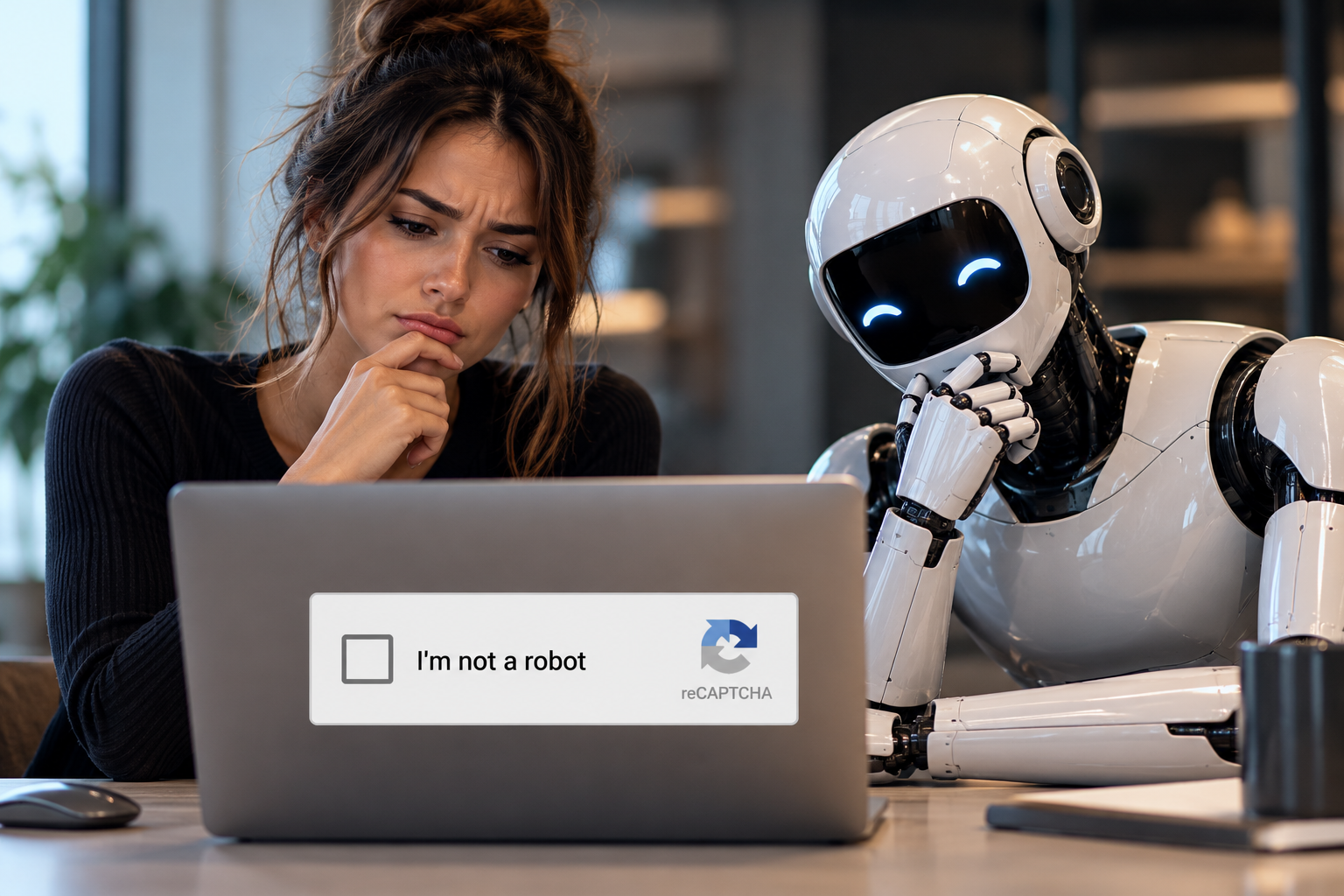
Almost everyone who uses the internet has been stopped by a small, suspicious question. A box appears, letters melt into waves and shadows, and the page asks for proof that a real person is sitting at the keyboard. It is an interruption so common that most people no longer think about how strange it is.
To buy, comment, register, or simply continue reading, a human must first convince a machine that they are not a machine. That odd ritual has a name, CAPTCHA, and behind it sits one of the internet's great ironies. The test was built to keep automated programs out.
Over time, the answers people gave to pass that test helped train automated programs to read text, recognize objects, and understand the visual world. The gate built to separate people from machines became one of the places where machines learned from people at enormous scale.
Spam, Fake Accounts, and a Problem of Trust
Around 2000, spam bots were flooding forums and creating fake accounts across the growing web. Sites that depended on open sign ups, comments, polls, and free email accounts faced a basic problem. A person might create one account and behave badly, but a program could create thousands, post endlessly, and return the moment it was blocked.
Luis von Ahn, at Carnegie Mellon, working with his mentor Manuel Blum, co created CAPTCHA, which stands for Completely Automated Public Turing test to tell Computers and Humans Apart. The first versions showed distorted text that humans could usually read and bots at the time could not. The distortion was the point.
People are remarkably good at recognizing letters through noise, warping, and clutter, while early software was easily confused by the same tricks. The idea spread because it solved an immediate pain without asking sites to close their doors. The web could stay open to strangers, at least in theory, while still asking each stranger a question that was easy for a person and hard for a script.
That balance, openness with a checkpoint, became a model for much of online life that followed, from account creation to ticket sales.
Two Words, One Known and One Lost
In 2007, von Ahn launched reCAPTCHA, a version with a second purpose hidden inside the first. Instead of showing one distorted word, it showed two. One word was known to the system, and that answer checked whether the visitor was human.
The other word came from scanned books and newspapers that optical character recognition software had failed to read. By solving the challenge, users helped digitize the New York Times archive and Google Books. A task that took seconds, repeated by millions of people, became a vast collective transcription project.
Words that had resisted machines were returned to searchable text, not by a room of typists, but by visitors who thought they were only proving they were real. Google acquired reCAPTCHA in 2009, a sign of how valuable the system had become. The acquisition also marked a change in scale and ambition.
What began as a defense against spam now sat inside the company that was organizing much of the world's information. The little box was connected to library shelves, newspaper history, search, maps, and eventually machine learning itself.
From Melted Letters to Traffic Lights
As text recognition improved, the test moved into images. Later versions asked people to work through grids drawn from Street View, selecting traffic lights, crosswalks, storefronts, and other features of ordinary streets. Anyone who has stared at a blurry square, unsure whether a corner of a sign counts, knows this version well.
Those answers did more than check a visitor. They labeled visual data. Each click helped describe the world in categories that computers could learn, a curb here, a crossing there, a shop front in a patch of a larger photograph.
The scenes were mundane because the world machines needed to understand was mundane. Streets, vehicles, signs, and buildings rarely announce themselves clearly, and teaching software to notice them required countless human judgments. This is where admiration for the invention begins to sit beside discomfort.
The work was tiny, almost invisible, and rarely presented as work at all. People were trying to reach their bank, their inbox, or a checkout page. In passing, they were also building a labeled record of books and streets.
Some saw ingenuity, a waste moment turned useful. Others saw a bargain they had never knowingly agreed to, measured in seconds and clicks.
The Test That Trained Its Opponent
The deeper irony is that the test meant to separate humans from machines supplied training data that helped machines get better at the same tasks. Text CAPTCHAs eventually became solvable by artificial intelligence at very high rates. Images that once confused software became training material for software that recognizes images.
A defense built on human perception pushed researchers and systems to imitate human perception more closely. That cycle explains why verification kept moving. Distorted words gave way to checkboxes, image grids, and then increasingly to invisible and behavioral checks that watch patterns such as timing and movement rather than asking a direct question.
A system that interrupts everyone is secure in one sense and hostile in another, because every false rejection locks out a real person who simply could not read the letters or interpret the photograph. Accessibility sits at the center of that debate. A test based on seeing distorted text or selecting small images assumes a certain kind of vision, device, connection, and patience.
Audio alternatives have often been criticized as difficult in their own right. For people using assistive technology, an old connection, or a shared computer, proving humanity can become the hardest part of using a service that was supposed to be open.
Frustration as a Cultural Experience
There is also the simpler emotional truth, which is that people resent being doubted by a web page. The language of the challenge may be polite, but the experience can feel accusatory. Fail once, and another grid appears.
Fail again, and the page seems to trust the visitor even less. The more the internet asked people to prove themselves, the more normal that suspicion became. Yet removing the test entirely is not a clean answer either.
Spam, fraud, credential attacks, and automated abuse are real, and sites without defenses can become unusable. The argument is not between safety and freedom in a simple sense. It is about where the burden falls, who carries it, and how often an ordinary person should have to perform their humanity for access to ordinary services.
CAPTCHA endures because the problem it named never went away. The web is built for both people and programs, and the line between them keeps shifting. Von Ahn's distorted letters began as a clever answer to bots flooding forums in 2000.
Two decades of reCAPTCHA turned that answer into a mirror. In trying to show what machines could not do, people kept teaching machines how to do it, one word, one traffic light, and one crosswalk at a time.
The Real Business Cost of a Difficult Verification Test
Imagine a homeowner searching for urgent plumbing help. They reach a website, fill in a contact form, and are asked to identify traffic lights in a series of tiny images. The first attempt fails.
On a phone, the next grid is even harder to see. They abandon the form and call a different company. The first business may never know an inquiry was lost.
For a business website, security and lead capture have to be evaluated together. Hidden trap fields can catch simple automated submissions. Rate limiting can reduce repeated abuse.
Server validation can reject malformed entries. More advanced verification can reserve visible challenges for suspicious activity rather than making every visitor complete one. No method is perfect, so the result needs testing with real submissions.
It is also important to check where messages actually arrive. A contact form can look complete on the page while failing to deliver to the company's inbox or customer management system. A chat interface can appear interactive while typed questions lead nowhere.
Spam prevention should protect the business without silently blocking the people trying to hire it.
The goal is not to make a customer prove humanity as dramatically as possible. It is to let genuine customers communicate easily while keeping automated abuse manageable.